About the Parish
The Parish of Pelynt lies a mile inland from the South coast of Cornwall and contains a little over 4000 acres of land. The Parish is bounded on the East by the West Looe river and the Parish of Duloe, on the North by Lanreath, on the South by Talland and on the West by Lansallos. Apart from the West Looe river much of the remaining Parish boundary is denoted by streams and hedges. This area has a long history of occupation, worked flint some dating from as early as 8000BC has been found on many of the farms. Several Bronze Age burial mounds can be seen and people have been farming in this area for around 4000 years.
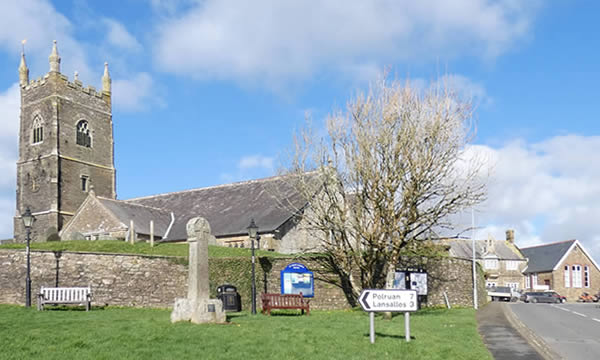
The Parish is roughly circular in shape with the only Village, the Churchtown, in the centre. The area is a farming community and has approximately 1100 inhabitants. Christianity probably came to Pelynt in the 6th century. The present Church, dedicated to St Nun, stands withing an Iron Age round. The word ‘Plunent’ appears in the Doomsday Book and means the Parish of St Nun. It is one of the earliest recorded mentions of the word ‘Parish’, although in 1806 the area was administered by Manors rather than the later ‘Parish’ system. In the 13th century a Chantry Chapel, dedicated to St Nun, stood within a Hill Fort near Muchlarnick. Her Holy Well can still be seen at Hobb Park, where there is public access to it. The present Parish Church, part of which dates from the 14th century, is a Grade 1 listed building. It is an early ‘Lan’ site and almost certainly stands on top of a much earlier Church. The Parish contains two buildings listed as Grade 2 dating from the 14th and 15th centuries and several Grade 2 houses dating from the 17th to the 19th century.
Pelynt is known as the birth place and home of Bishop Sir John Trelawny of whom we sing in the Cornish Anthem. In 1688 he, along with six other Bishop’s, refused to have read in their churches the King’s ‘Declaration of Indulgence’ that would have given more freedom to Catholics in this country. The ‘Seven Bishop’s’ were arrested and put in the Tower of London where they remained for a couple of weeks before being tried and found not guilty of seditious libel. Their release was celebrated both in Cornwall and further afield. In Pelynt we still celebrate the release of the Bishops on the 30th June every year and end the event with a rousing rendition of the Cornish Anthem ‘Trelawny’.
During the 19th century most men and boys worked on the land but with the introduction of revolutionary new farm machinery towards the end of that century many families left the Parish to work in the rapidly expanding industrial towns of England. Farming is still an important part of the economy in this area but tourism is now equally important.